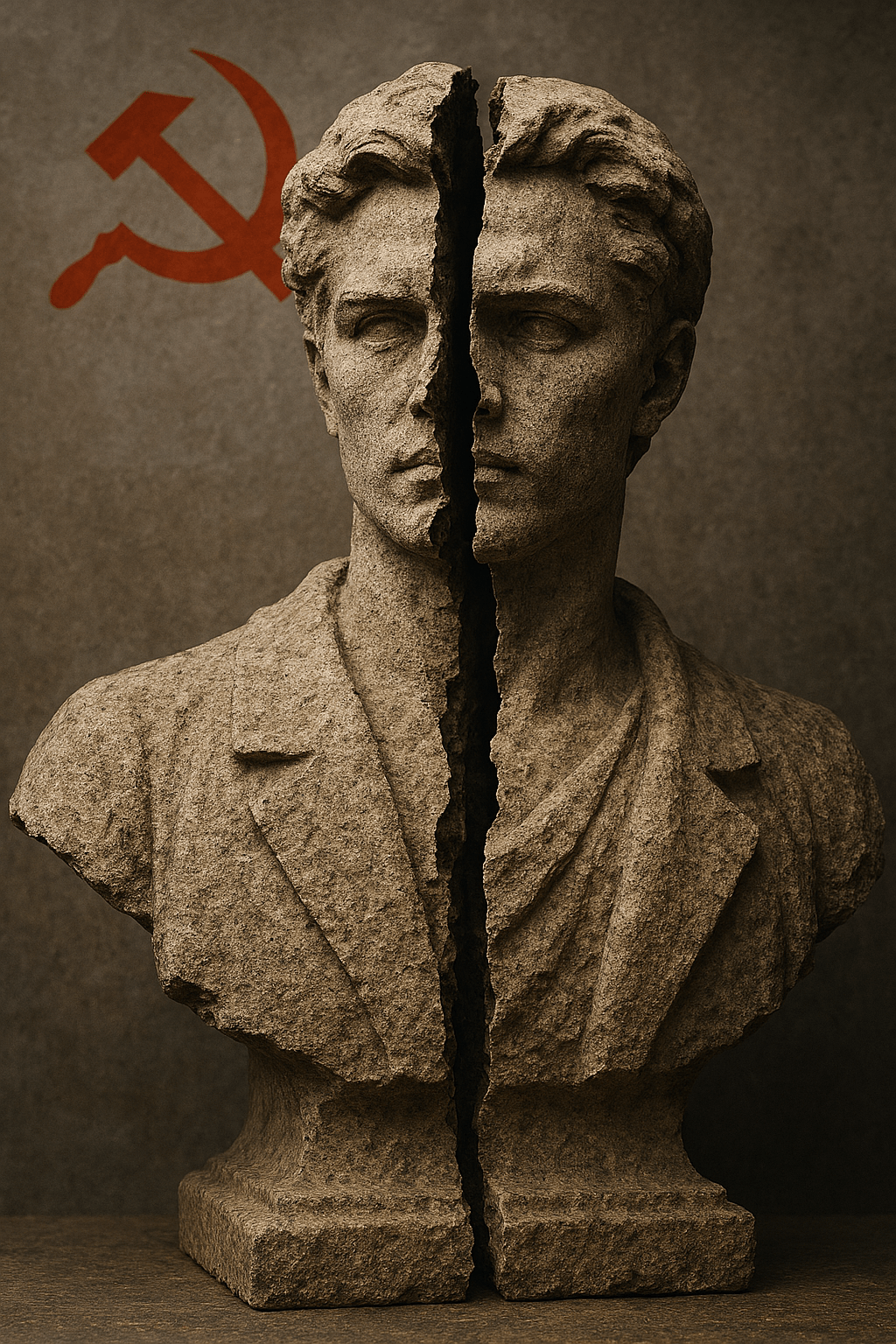
A personal reflection
Communism, as envisioned by Karl Marx and Friedrich Engels, is one of the most ambitious and radical ideas ever proposed in political history. Its central premise is deceptively simple: a classless society, no private ownership of the means of production, and no inequality. A community where everyone contributes according to their ability and receives according to their needs.
But beyond the theory, a question inevitably arises: Can human nature sustain such a system?
🌱 Communism as a concept
In its purest form, communism is an ideal. A vision of social harmony where hierarchies, privilege, and exploitation vanish. It appeals to the best in us: solidarity, cooperation, and a sense of community.
Yet it remains just that — a concept. A theoretical construction that has never materialized as originally imagined.
🧱 The clash with reality
The problem begins when this ideal is put into practice. For communism to work, society would need to be one where:
- no one seeks power,
- no one wants to control resources,
- no one desires more than others,
- no one acts out of self-interest,
- and everyone shares a perfect collective consciousness.
But that doesn’t align with human nature. We are beings of ambition, desire, fear, insecurity, and individual aspiration. And when a system demands that we abandon those traits, it inevitably collides with reality.
🧑⚖️ The inevitable rise of a new elite
In every historical attempt to implement communism, the same pattern emerges: a ruling class appears — a group that manages, decides, and controls.
That group — the party, the committee, the leader — becomes the new elite. And at that moment, the system ceases to be communist, because:
- if there are leaders, there is hierarchy,
- if there is hierarchy, there are classes,
- and if there are classes, equality disappears.
The result is a model where power concentrates, freedom shrinks, and inequality persists — only now disguised as “equality.”
🔥 A utopia that doesn’t fit human nature
Communism doesn’t fail because of evil or conspiracies or external enemies. It fails because it demands that humans stop being human.
It asks us to renounce ambition, the desire to improve, the need for recognition, the longing for freedom, and the diversity of thought. It asks us to think the same, act the same, live the same.
And that is not possible.
🎯 Conclusion
Communism, as a concept, is a utopia: a beautiful idea, but incompatible with human nature. Not because we are bad, but because we are complex. Because we seek to grow, to choose, to create, to compete, to evolve.
History shows that every time a system tries to suppress that reality, it ends up producing the opposite of what it promises: less freedom, less equality, and less prosperity.
Reflecting on this is not an attack on ideology — it’s a recognition that no system can succeed if it ignores what we are as human beings.
 “Juan – Reseñas con Sentido”
Deja un comentario